BACK
Momento - A Memory Companion
Vibe-coded a conversational agent powered second brain in Google AI Studio linking people, places, chats and memos automatically inferred from user activity.
Problem
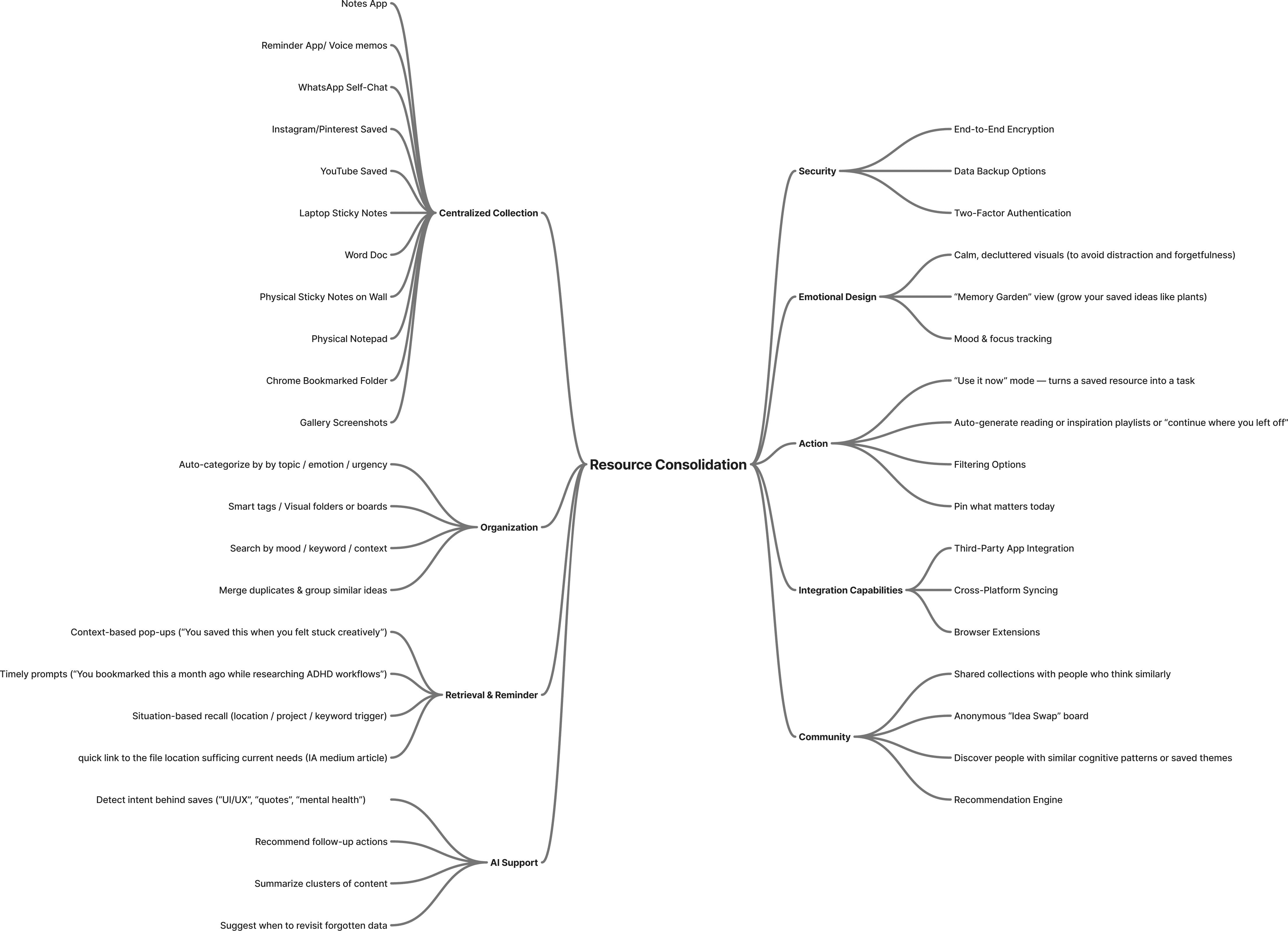
Users must expend mental energy just to remember where they saved something. This problem is not fundamentally a "note-taking" problem.
It is a memory fragmentation problem.
People no longer have a single place where knowledge lives. Instead, knowledge gets distributed across dozens of systems, each optimized for a different moment of capture. Over time, the challenge shifts from capturing information to finding it again.
Behavior Pattern
Self-messaging - Users send messages to their own WhatsApp numbers, draft emails to themselves, or keep a single perpetual "Notes" page that acts as a dumping ground. These locations have high write-fidelity (instant access) but zero retrieve-fidelity.
Silo-hopping - When looking for a piece of information, a user runs the same keyword search sequentially across several applications (Sequential Brute-Force Search) starting with Notes, moving to Reminders, then searching self-chats/saved collections, and finally checking local filesystem directories.
Guessing game - Users often look up information by trying to align it with their spatial episodic memory: "I know I saved this link right after switching to another project last October." They then manually scroll back through chronological feeds to find the entry.
Syntactic Rephrasing - When a search fails, users guess synonyms sequentially (e.g., trying "UI/UX", then "design", then "zero-code", then "figma mcp") hoping to trigger an exact match.
Why current solutions fail?
Productivity suites (Apple, Google, Microsoft) are structurally incentivized to lock users into their proprietary ecosystems. They do not build indexers that span across competitor boundaries, preventing a unified index of Apple Notes and Microsoft Calendars.
Existing unified OS-level search engines (such as macOS Spotlight or Windows Search) index files by metadata and basic OCR on local files, but lack semantic understanding. They treat a screenshot, a 10-second voice memo, and a text file as structurally separate entities rather than connected thoughts.
Knowledge bases like Notion require continuous organization, folder nesting, and tag maintenance. When users fall behind on this database maintenance, the system degenerates. A system that requires manual organization is doomed to fail under real-world input velocity.
Building a centralized index requires scanning highly sensitive personal artifacts (bank details, relationship conversations, private drafts). Standard SaaS search tools require full cloud-connector permissions, creating a major trust barrier for privacy-conscious users.
Approach
Semantic understanding eliminates the need for manual folders or tags. AI can analyze unstructured input, categorize its core themes, and link it back to similar concepts automatically.
Representing multi-modal information (voice transcripts, screenshots, emails, rich text) in a unified vector space. This allows a user query like "the wireframe idea I drew in the workshop" to retrieve a scanned visual file.
Traditional search systems return a list of links, forcing the user to open each one and scan for content. AI can act as an oracle, synthesizing the final answer directly from these disjointed elements while providing citations.
User: "What is my garage gate code and who gave it to me?"
AI: "The gate code is 4920#. This was sent by your landlord Mark in an email on July 14th, and you also saved a photo of the keypad inside your camera roll."
More


